

The Celebration Industrial Complex
We celebrate everything now. A toddler turns two? Cake. Did you survive your first day at a new job? Drinks. 100 subscribers on Substack? Expensive dinner. Just don't forget to post it.


A celebration isn’t just a celebration anymore. In the big age of 2026, a celebration lives in a dichotomy of content or waste. It’s either something you could put on your Instagram and accrue influence, followers and wealth or it’s not. And, in order to put it on your social media, it must be aesthetically pleasing and algorithmically relevant. It cannot be a simple house party; it must resemble X Party. It cannot be a simple brunch; it must be Breakfast at Tiffany’s. It cannot be enough to leave the country; you must have a cinematic B-roll of the scenery. If it’s not relevant to the SEO, no one will see it. If it’s not drop-dead gorgeous, no one will like it. And how can you break into 1k likes per post if you lack both of these? If you don’t have this, it basically never happened. The 2020 COVID pandemic put this performance into hyperdrive. Now, everyone is overcompensating once realizing they have no photos of themselves before 2020, all the sudden. Especially the Class of 2020, at their graduation, they never had. (too soon? LOL?)
The “Celebration Industrial Complex” is basically how social media, trends, and group pressure turn normal gatherings into content. Platforms boost whatever looks neat and pretty, so people start believing a celebration only “counts” if it’s photographed. It only “succeeded” if the photos look perfect. Things like cost, accessibility, and logistics get pushed aside so the event can look good online. It’s not just vanity; algorithms reward polished images and hide anything ordinary. Research on “consumptive curation” shows people are conditioned to post what performs well and avoid what doesn’t, creating a cycle where curated visuals rise and real moments disappear. As a result, everyone feels pressure to make every celebration look “post‑worthy,” even when it drains time, money, and joy.

Say Cheese!
So, what happens once everything is content? It means everything becomes a photo op. Aesthetics are the driving force over logistics and accessibility. Take this bridal shower I was invited to:
$75 for AYCE brunch at a decent restaurant, Toast on Lenox, specifically.
Too expensive! A guest said it was too steep for their budget for just some brunch. Then, this second option emerged:
Drive 2 hours for a severely reduced menu at another restaurant for $55
And you’d better bring a gift. (it’s tacky not to, no matter what the bride said.)
And it begs the questions: why am I paying for inconvenience? Why am I paying to work harder to celebrate with you? Do you even want to celebrate with me? If you did, why does it feel inconsiderate? And not on some bullshit that the price of community is inconvenience, inconsideration, it’s on, ‘oh, this will literally cause financial or mental or physical strain on me.’ Strain. $75 is some people’s bill. That four-hour drive back and forth is more time than their PTO allotted. It gets to a point where you must ask if you want people to show up for a celebration or as an excuse to populate your Instagram feed.

Pressure to Perform
Celebrations like this are how we get into a culture where people, especially women and femmes, feel enormous pressure to perform and provide an experience and by convincing them that the beauty of the event matters more than their own bandwidth, so it’s disrespectful of them to not attend and rebel in the performance.
This brews resentment for lack of consideration and expectations. Why? Because if you don’t show up, you’re ungrateful. You’re a bad friend. You’re “not supportive.” Meanwhile, the host is also drowning under the pressure to make everything perfect, majestic, and transcend onto the camera. It’s emotional labor on both sides, but only one side is allowed to say they’re tired.
The Inconsiderate Business Plan
A friend of a friend asked me to help plan a bridal shower. Of course, I said yes, I’ll help. It’s my friend, and I love her, and I love to celebrate her. Even though I had my reservations about said friend, I figured what could go wrong? Just for it to go completely wrong.
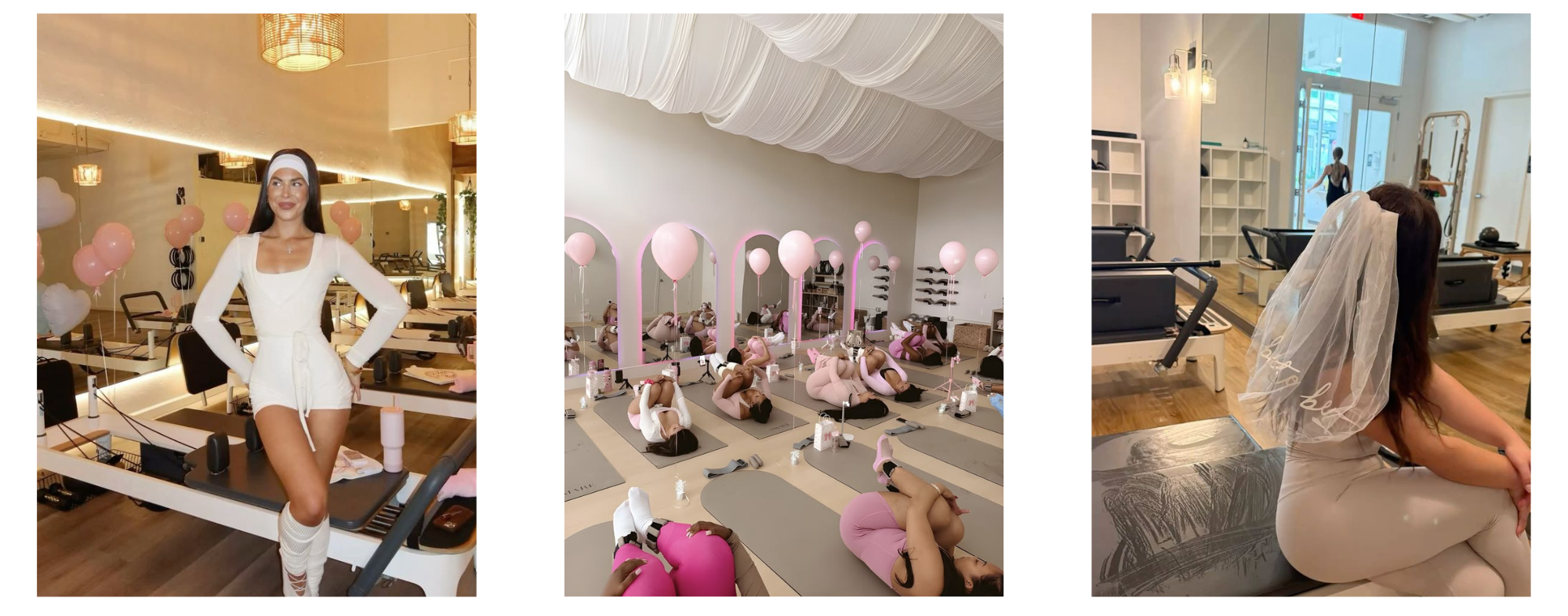
At first, she sent me a Pinterest board: girls in their clean girl aesthetic with their matching pastel outfits in grippy socks doing Pilates. That was all on the Pinterest board, just people doing Pilates and smiling at each other. Cute concept! Then, she sent me this text right after.
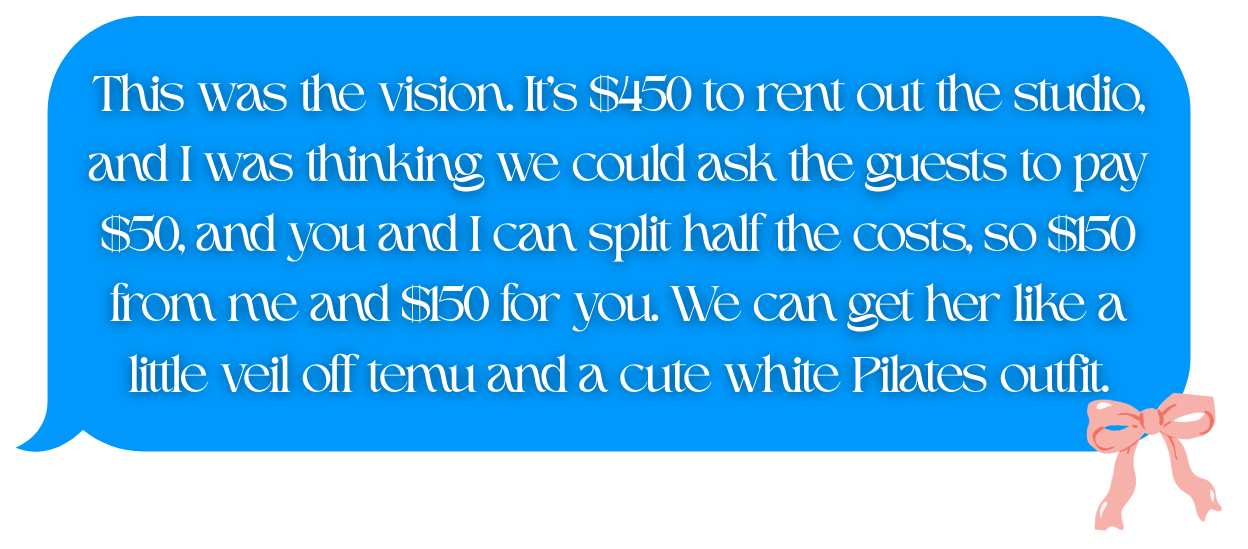
Deadass. Word for word. No, what do you think? Do you think the bride would like it? Is it something the bride’s 50+ year old guests would show up to? None of that. Suddenly, I wasn’t helping. I was being recruited and delegated to fund a business plan disguised as a bridal shower. I felt furious. Not to mention my own strifes and tribulations, such as $100 law school applications and the uncertainty of my life post July, and I’m supposed to spend that last month executing someone else’s fantasy?
Hell no.
When I said I couldn’t contribute $150, but I could do $50, she blew up. Not at me. She didn’t have the gall to do that. Instead, she triangulated and blew up at the bride, discussing my transgressions as a friend. Suddenly, I wasn’t a good friend. I was a stingy person, someone who was difficult. That’s when I realized that I wasn’t being asked to help. I was being asked to be exploited. For what reward? A beautiful scene where you get no credit, no thank you, no I appreciate you, but at least you leave with a nice photo to upload.
Other Examples
Authentic is a further extension of being real. A lot of things on social media are kind of the opposite of authentic. A lot of things these days can feel staged, sort of like the Super Bowl halftime show. Such online stuff is often heavily curated by people to present unreal images of themselves and sell you stuff, including selling you a packaged version of themselves. Across the internet, other people are describing the same thing:
- One Redditor’s best friend demanded $150 from each guest to fund her own birthday party, prompting commenters to call it what it was: entitled, tacky, and the opposite of community.
- ABC News reported on a bride who charged $300 per person to attend her bridal shower, sparking outrage online. Most commenters agreed that charging guests, who are also expected to bring gifts, isn’t etiquette, it’s entitlement.
- A woman shared that she was invited to a bridal shower where the bridesmaids informed guests that everyone would need to pay for their own high‑tea meal and chip in for a group gift the bridesmaids had already chosen: a Tiffany bracelet.
- A WeddingBee user whose friend kept inviting her to expensive events and guilt‑tripping her for having financial limits.
- A New York Times letter from a couple who believed that inviting friends to their vacation home entitled them to expect guests to cover additional expenses.
The details differ, but the pattern is identical: entitlement and unspoken financial expectations.
And the data backs it up:
49% of people say they wish events felt “less curated and more real.”
92% of consumers use social media, but two‑thirds say it makes them feel worse and more disconnected.
48% of Gen Z and 40% of millennials spend money they don’t have because of social media aesthetics.
86% of Gen Z and 77% of millennials regret overspending in 2024.
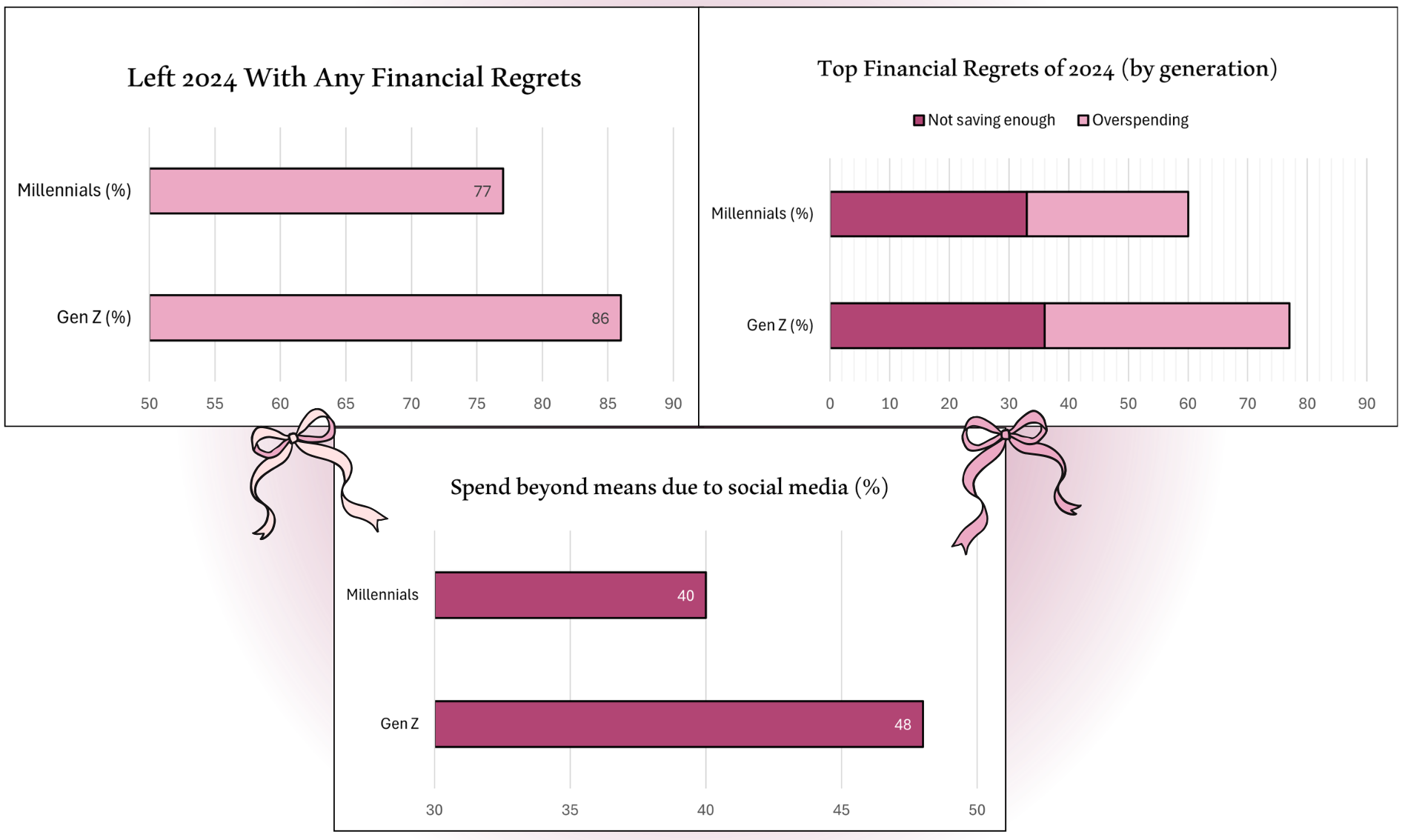
Celebration culture isn’t just expensive, it’s emotionally and financially extractive. These aren’t isolated incidents; they’re part of a broader cultural pattern.
Infantilization and Avoided Accountability
Historically, domestic femininity in the United States was staged atop someone else’s labor: middle‑class white women curated the home while Black and immigrant women performed the physical, emotional, and domestic work that made that curation possible. Sociologist Patricia Hill Collins calls this the Matrix of Domination—a system in which some women’s performances are subsidized by others’ unacknowledged labor. This dynamic still echoes with which some people delegate, demand, or expect others to absorb the cost, planning, and emotional labor of their celebrations.
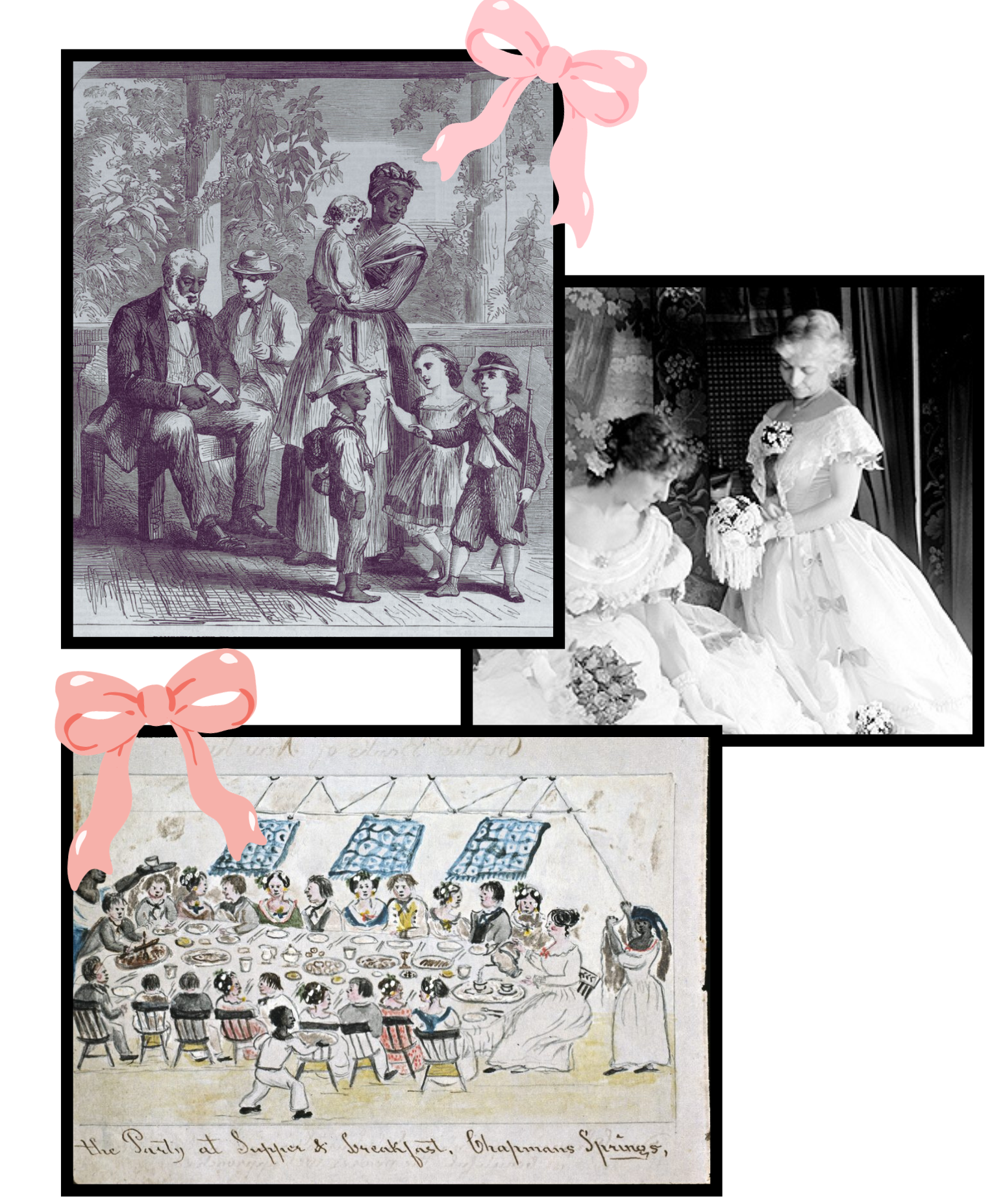
Beneath the aesthetic lies a pattern of infantilization; adults casting themselves as incapable of handling budgets, logistics, or decisions, thereby absolving themselves of responsibility. They want the appearance of generosity without the effort of hosting; the event without labor; the aesthetic without accountability.
That’s exactly what happened in my own situation. The moment she sent that Pilates Pinterest board, it was clear I wasn’t being invited to collab, I was being recruited to execute and subsidize someone else’s fantasy while they floated above the work as the “visionary.”
Infantilization can also show up emotionally. Over time, this can create learned helplessness. If someone is constantly rescued, corrected, or accommodated, they stop developing the muscles required for accountability. They become passive in their own lives and dependent on others to make things happen, often leading to other narcissistic personality traits, like the victim complex: the belief that one’s life is entirely under the control of forces outside oneself, such as fate, luck, or the mercy of other people.
When you stop participating in that system, you’re refusing to be the caretaker in someone else’s fantasy. This is why the reaction to a boundary is often manipulative tactics, such as guilt tripping or emotional punishment, when it should be understanding and compassion.

Choose yourself, love yourself
If the goal is to celebrate as communion rather than content, these three principles should help. First, accessibility is paramount. Plan around people, not pictures. Make it a time, place, and date that most people, if not everyone, can attend and enjoy. Second, transparency, especially about the costs, is needed. If an event requires cost‑sharing, name the official number upfront. Do not change the number, and do not come to people with a changing number. This is a party, not stocks. If the number is too much, offer opt‑in alternatives (potlucks, sliding‑scale contributions, etc). The moment an invitation becomes an invoice, it is no longer hospitality. And last, but not least, please respect declination. It’s not personal, but it’s an individual’s prerogative to decline.
And here is the quiet revelation: saying no doesn’t destroy anything worth keeping. The backlash you feared passes. Your dignity feels better than any curated moment. Once you choose your peace over someone else’s performance, you begin to see how many celebrations were never about community at all; they were about optics. And the moment you step out of the role of perpetual accommodator, you reclaim your joy.
This is amazing.
and that’s why for 100 subs i will be making you all go to a $100 brunch lol jkjk